Haute couture pleating is not a single craft but a family of them, and the most storied houses rely on three distinct hand methods: cardboard pleating, draping in the manner of Mme Grès, and Fortuny pleats. Each produces a different result—architectural precision, sculptural fluidity, or a fine, elastic texture—and none can be reduced to the regular, repeatable patterns that industrial pleating machines produce. The distinction matters commercially as well as aesthetically: couture houses outsource this work to specialized ateliers whose hand skills machines cannot replicate.
Cardboard Pleating: Precision and Permanence
Cardboard pleating is the technique most closely associated with Parisian haute couture, and its leading exponent is Atelier Lognon, a pleating house founded in 1853 that became a major player in Parisian couture by 1945 and joined Chanel's Métiers d'Art in 2013. According to the craft platform Homo Faber, which profiles the atelier, each fold is traced and carefully broken by hand to form a cardboard mould, with every type of pleat demanding its own precise process. The atelier holds an archive of more than 3,000 patterns spanning different periods and styles.
The process itself, as described by Céline Vautard in FashionUnited's reporting on the atelier, is a controlled sequence of preparation, heat, and patience. The fabric—silk, crepe, tulle, muslin, organza, velvet, and even leather or polyester—is first ironed flat. It is then placed alongside the cardboard mould, rolled up in it, and put into an oven at between 85°C and 100°C for one hour to one hour and thirty minutes, depending on the material. The mould is then left for a full day to cool, so that the fabric definitively takes the form of the pleat before it is removed.
The result is sharp, precise, and permanent pleating: the heat-setting fixes the fold into the fabric's structure rather than merely pressing it. Gérard Georges Lognon, the founder's great-grandson, describes the skill as "an enabler of fabrics." Floriane Schmitt, a fashion practitioner who documents fabric manipulation techniques, notes that this style is completely hand-made and reserved for haute couture garments or small-scale productions—precisely because each mould is traced and folded by hand.
Draping: Organic Flow and Sculptural Form
Where cardboard pleating imposes a predetermined pattern onto flat fabric, draping works in the opposite direction: the pleats are formed directly on the body or mannequin. Schmitt describes the technique in the manner of Mme Grès—pinning the desired pleats onto a mannequin and then stitching them together. The pleat is not heat-set into existence; it is sculpted, fold by fold, in response to the three-dimensional form beneath it.
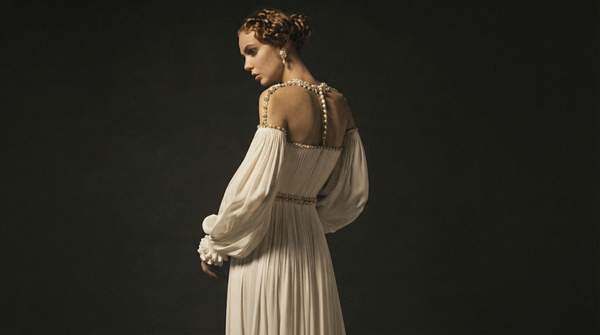
This is the crucial distinction from industrial methods. A machine can only produce quite regular patterns, as Schmitt observes—accordion pleats, side pleats, sunburst pleats. Draping allows an organic, sculptural approach in which each pleat responds to the curve it must follow. The aesthetic effect is soft and fluid: pleats that flow around the body rather than standing in rigid parallel lines. Mme Grès, the couturière whose name has become shorthand for the technique, was a renowned master of this method, and garments made this way bear the mark of a single pair of hands rather than a die or a roller.
The trade-off is reproducibility. Schmitt notes that hand-made pleats are produced by expert pleaters only, and that achieving the same effect across several garments in production is quite technical. A draped pleat is, by its nature, a response to a specific form; copying it exactly is far harder than running another length of fabric through a machine.
Fortuny Pleats: Timeless Texture and Movement
The third technique carries the name of its inventor: Mariano Fortuny, the early twentieth-century Venetian master of silk, dyeing, and pleating, whose pleats were made entirely by hand. His method remains a proprietary secret—no published process explains it—but its effects are well documented. Fortuny pleats are characterized by a fine, irregular texture, unlike the uniform folds of machine work, and by a remarkable capacity to expand and contract with the movement of the body, which suits luxurious, flowing garments.
What made the pleats exceptional, according to a resource cited on the Fashion-Incubator blog, is that Fortuny's garments were all pure silk, and the pleats stayed sharp during wear. The same source reports that the pleats remained sharp even after the fabric was wet—a claim the blog's author flags with appropriate caution, writing that "if true, it makes his genius more evident." The durability is the point: these are not pressed folds that relax over time but a texture apparently locked into the fiber itself.
The same blog, discussing a book on haute couture artisans, records a sobering context for the craft: "these artisans are quite elderly, and with the increasing costs of handwork and too few skilled replacements, it's likely their businesses will eventually close." Fortuny's secret died with him; the living techniques depend on ateliers training successors.
Comparative Overview of Haute Couture Hand-Pleating Techniques
The three techniques can be distinguished by their core process and the garment texture or form each one creates. Use this table to identify which method a given pleated garment likely reflects.
| Technique | Method Summary | Primary Aesthetic Effect |
|---|---|---|
| Cardboard Pleating | Fabric is ironed flat, rolled into a hand-traced cardboard mould, heated in an oven at 85°C–100°C for 1–1.5 hours, then cooled for a day. Performed by specialized artisans such as Atelier Lognon. | Sharp, precise, permanent pleats; the heat-setting fixes the form, giving the fabric unique texture and volume. |
| Draping (à la Mme Grès) | Fabric is draped directly on a mannequin or body, pleats are pinned in place, then stitched together—an organic, sculptural approach. | Soft, fluid pleats that flow around the body; Mme Grès was the renowned master of this technique. |
| Fortuny Pleats | Created by a secret heat-setting process invented by Mariano Fortuny in the early 20th century; the specific method remains proprietary. | Fine, irregular texture that expands and contracts with body movement; reported to stay sharp even when wet. |
Read side by side, the comparison shows why couture treats pleating as a discipline rather than a finishing step. Cardboard pleating achieves permanence through heat; draping achieves fluidity through direct sculpting; Fortuny pleating achieved a texture so bound into the fiber that it survived wear and water. Machine pleating, by contrast, is defined by regularity—accordion, side, and sunburst patterns repeatable at scale, as in Issey Miyake's "Pleats Please" line, where garments are sewn three times oversized and pleated down to their final size.
Recognizing the Craft: Identifying Hand-Pleated Haute Couture
When encountering a garment with intricate pleating, consider whether its precision, fluidity, or unique texture suggests artisanal hand-pleating rather than machine production. The evidence points to concrete markers. Look for irregularities, organic flow, or specific textural qualities that are difficult to replicate mechanically, such as the fine, irregular texture of Fortuny pleats or the sculptural drape of Mme Grès-style pleating. Perfectly uniform accordion folds signal a machine; a pleat that follows a curve, responds to the body, or bears a slightly irregular grain is the signature of a hand.