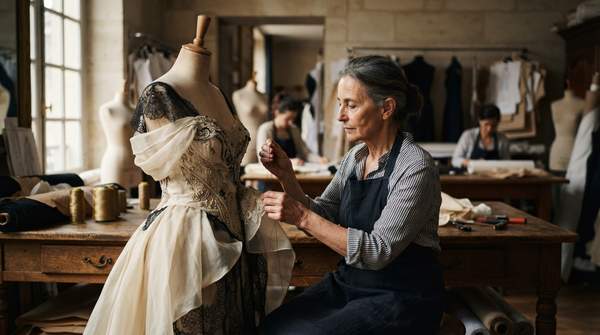
A haute couture garment is never the work of a single pair of hands. It is the product of a structured atelier divided into two core workshops—flou for soft garments, tailleur for structured pieces—supported by a network of external specialists in embroidery, feathers, flowers, and millinery. Understanding who does what, and when, is the key to appreciating how a sketch becomes a made-to-measure reality.
The Core Workshops: Flou and Tailleur
Couture workshops have historically distinguished between two areas of expertise. Flou is associated with softer garments such as dresses and blouses, where fabric falls, drapes, and moves with the body. Tailleur governs more structured pieces—suits, coats, and tailored constructions that hold their own architecture. The division is not hierarchical but technical: each demands a different relationship between hand and material.
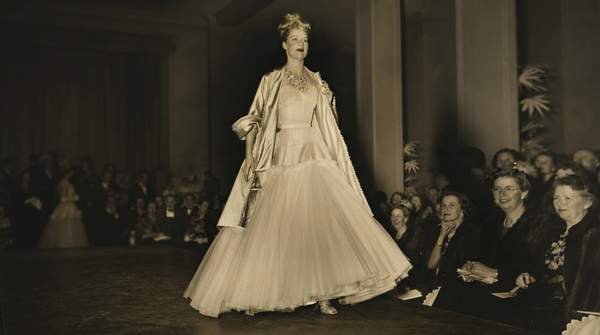
Within these workshops work the petites mains, the skilled artisans who execute complex designs with precision, transforming a designer's sketches into finished garments. The historical model is Christian Dior, described in one account as "the ultimate conductor in his atelier," collaborating intensely with his famed petites mains. His iconic "Bar" suit—with its padded hips, nipped waist, and hand-stitched details such as self-covered buttons—exemplifies the obsessive craftsmanship the system demands.
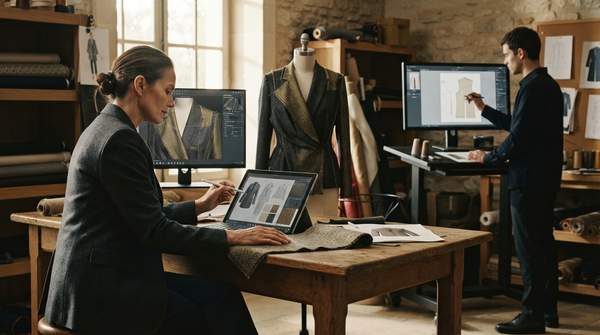
Overseeing it all is the head of atelier, a role whose contemporary scope is visible in a job posting from the house of Iris van Herpen. There, the position entails managing collection development from concept to completion, supervising the construction of each garment, overseeing sample development and tailor-made client orders, acting as the main client contact, handling budgeting, and applying patternmaking expertise to create and adapt made-to-measure patterns.
The Haute Couture Creation Journey: Roles and Techniques
The creation of a single garment follows a recognizable sequence, though specific workflows vary between houses. The model below maps each stage to the roles and techniques responsible for it, drawn from descriptions of atelier practice and the documented responsibilities of atelier leadership.
| Stage | Key Roles | Core Techniques |
|---|---|---|
| Concept and sketch | Designer, head of atelier | Collection planning; translating design vision into a buildable object |
| Patternmaking | Head of atelier, pattern specialists | Made-to-measure pattern creation and adaptation; at some houses, laser-cut file placement using Adobe Illustrator |
| Construction and assembly | Petites mains in flou or tailleur | Hand-stitched construction; iterative adjustment and refinement of the working garment |
| Embellishment | External métiers d'art workshops | Embroidery, featherwork, artificial flowers, pleating, buttons |
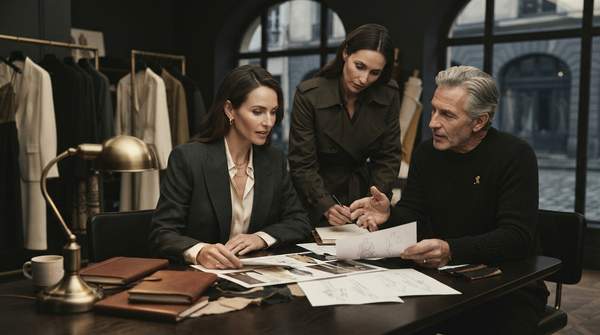
| Client fittings | Head of atelier, tailors, client | Successive fittings to refine proportion and movement on the individual body |
Two features of this sequence deserve emphasis. First, the process is iterative: a finished garment may look assured, yet its shape emerges through adjustment and discussion, examined and changed until the relationship between intention and construction becomes convincing. Second, fitting is not a final formality but part of construction itself. Haute couture has historically depended on a precise relationship between garment and individual client, with successive fittings allowing proportion and movement to be considered on a particular body—which is why a photograph cannot capture everything that matters.
Contemporary practice also shows the model evolving rather than dissolving. The Iris van Herpen posting requires proficiency in Adobe Illustrator for laser-cut pattern integration alongside deep knowledge of couture construction, and calls for close collaboration among the designer, artisans, and petites mains to ensure fluid communication and timely delivery.