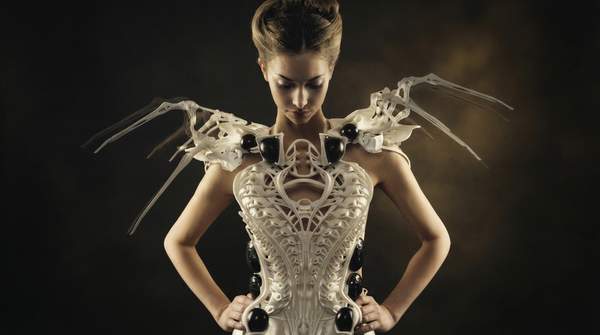
Luxury fashion's most radical garments now come from two very different digital machines, and the choice between them defines what a designer can achieve. Laser cutting excels at carving intricate, precise patterns into existing fabrics; 3D printing builds entirely new structures, layer by layer, from polymers or powders. Iris van Herpen uses both in a single collection, while Danit Peleg made history in 2015 with a clothing line produced entirely on 3D printers. Understanding where each technique excels is the first step toward translating a digital-age concept into a wearable piece.
3D Printing: Crafting Complex Forms and Textures
3D printing is an additive process: liquid molecules or powder grains are fused together layer by layer until a three-dimensional shape emerges. Because no cutting tools or molds are required, the technology allows complex structures to be created with relative ease compared with traditional manufacturing. Desktop machines melt plastic filaments and build objects layer upon layer, while industrial machines use a laser to melt thin metal layers or plastic powders.
For fashion, that additive logic opens two distinct paths. A designer can print directly onto fabric, bonding new material to an existing textile, or print a complete, standalone garment. The crucial constraint is material behavior: as one practitioner in the field puts it, "Initially, my design might come back crumbled into pieces, or it might come back perfect. You have to learn to design as per the material." The outcome depends on the specific design and the properties of the material chosen, and the evidence available does not detail the specific polymers used in most high-profile garment applications.
Laser Cutting: Precision for Parametric Patterns and Surface Embellishment
Laser cutting works in the opposite direction: it is subtractive, removing material from a base rather than building new material up. Its strength is precision. As long as the fabric is suitable for the laser cutter, almost all types of garments and accessories can be made from laser-cut materials, and laser-cut detailing has become commonplace at the luxury level. Laser cutters are also ideal for cutting and engraving acrylics, woods and stones, which extends their use into fashion jewelry.
The technique's most sophisticated expression is parametric design, where patterns are generated computationally rather than drawn by hand. This allows intricate, mathematically derived surfaces that would be nearly impossible to cut accurately by any manual method. The trade-off is structural: laser cutting shapes and decorates material that already exists, but it cannot create the multi-dimensional, self-supporting forms that additive printing can. Designers choosing between the two are really choosing between surface refinement and built structure.