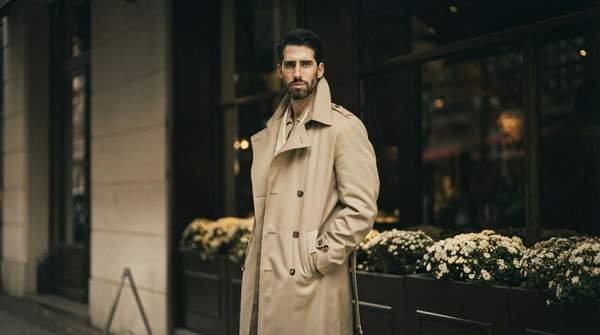
The trench coat is one of the rare garments whose every detail has a documented job. The epaulettes on the shoulders, the D-rings on the belt, the flap across the chest—none of these began as decoration. They were engineered for soldiers in the mud of the First World War, and their survival on today's coats is the clearest sign of how thoroughly utility became style. Understanding that transformation means following the coat through four distinct eras: the invention of waterproof fabric, its standardization in the trenches, its reinvention on screen by Hollywood, and its absorption into high fashion.
From Battlefield to Boulevard: A Chronology of Style
The story begins not with a coat but with a cloth. Lightweight waterproof fabric, as military historian Peter Doyle puts it, was "a technological development, like the Gore-Tex of that period, making a material that would be fit for purpose." Doyle, author of The First World War in 100 Objects—in which the trench coat appears as object number 26—points to the convergence of three things: the fabric, the factories, and the primary players, Burberry, Aquascutum and, to a lesser degree, Mackintosh. Once those elements were in place, the coat itself was, in his telling, only a matter of time.
What drove the design, though, was not fashion but a change in how the British military outfitted itself—and, crucially, in how war was now waged. Writing in The Rake, Nick Scott traces the tactical logic: long-range weaponry available by the Crimean War pushed garishly conspicuous uniforms out of fashion, and by World War I the need to blend into the landscape was imperative. So was the mobility to burst into action at short notice. Out of those demands came the utilitarian, functional, camouflaged coat we recognize today, complete with shoulder straps and D-rings.
The result was a garment defined by its contradictions. It was practical to the point of austerity, yet it carried an air of distinction; Smithsonian Magazine's account of the coat's rise notes its dual cultural role as outerwear associated with both the elite and the fictional "lone wolves" of detective fiction. A coat born in a context of what Scott calls "abject suffering" somehow emerged with its prestige intact rather than diminished.
The third era belongs to the screen. Asked what made a garment with such starkly utilitarian origins become the iconic and desirable apparel it is today, Scott's answer is blunt: "Inevitably enough, the short answer is Hollywood." The coat's transition from military issue to civilian wardrobe was not a marketing campaign but a series of memorable screen appearances that fixed the garment in the popular imagination as the uniform of the mysterious, the romantic and the resourceful. By the mid-twentieth century, the trench coat no longer needed a war to justify its existence.
The fourth era is the one still unfolding: high fashion's ongoing reinterpretation of the form. The coat's trajectory from military standard to designer staple is the culmination of the earlier stages—the fabric innovation gave it legitimacy as technical wear, the war gave it its anatomy, and Hollywood gave it desirability. Once a garment carries that much accumulated meaning, designers return to it repeatedly, precisely because its details are never merely decorative. The classic features survive each reinterpretation because they are the coat's identity.