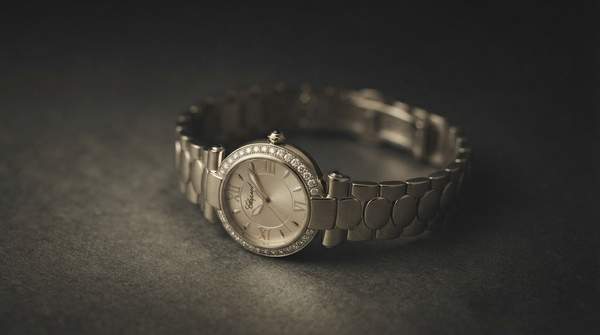
Luxury brands revive archival designs not out of nostalgia but out of strategic necessity: a heritage revival only works when it balances a consistent brand code with modern innovation. That is the central argument of a framework for building and sustaining luxury brands published in Rutgers Business Review, and Chopard offers a working demonstration of it. The Swiss watchmaker and jeweler has reintroduced two very different archival lines—Happy Sport and L'Heure du Diamant—using the same underlying logic: preserve what made the original distinctive, update what contemporary collectors expect, and wrap both in a narrative that connects past to present.
The Strategic Imperative of Luxury Brand Heritage Revival
Heritage is an asset that depreciates if left unused. The academic framework argues that luxury brands must develop a clear brand code and core value, stay relevant through internal and external innovation, and strike a deliberate balance between modernity and heritage. The goal is long-term brand equity: increased awareness, desirability, perceived prestige, and stronger resale value on the secondary market. The framework is grounded in the luxury watch industry, built from case studies, executive interviews, and consumer surveys, and it carries a caveat—it applies most cleanly to industries where brand equity dominates, and requires careful extension where technology evolves rapidly.
Crucially, the framework's authors insist that luxury brands are in the "market-driving and visionary business." They must educate and guide consumers in taste formation rather than follow customer feedback, and new products "must surprise and awe." The original brand code must remain salient as the brand evolves; if the evolution departs from the old, it must still balance modernity and heritage. Revival, in this view, is not replication—it is controlled reinvention.
Chopard's Heritage Revival Strategy: A Three-Pillar Model
The framework's three pillars—core strategy, product strategy, and marketing strategy—can be mapped directly onto Chopard's documented actions. The table below shows how each pillar operates in practice.
| Strategic Pillar | Chopard's Action | Heritage Interpretation | Modern Elements Introduced |
|---|---|---|---|
| Core Strategy | Balance brand code with innovation across revivals | Signature concepts retained: floating diamonds; watch-as-jewelry | New materials, campaigns and audiences for each generation |
| Product Strategy | Happy Sport revival with faithful proportions and floating stones | 1993 original: first watch combining diamonds with a stainless steel case | Reissued design with a small mechanical movement |
| Product Strategy | L'Heure du Diamant collection, introduced in 2012 and expanded with four new white-gold models | Early-1970s bracelets and unconventional dials treated as jewelry | Contemporary white-gold models extending the archival aesthetic |
| Marketing Strategy | Happy Diamonds 50th-anniversary campaign fronted by Bella Hadid and Liu Wen | Emphasis on the founding "diamonds liberated from their settings" concept | Film, choreography and photography framing diamonds as extensions of the body |
| Marketing Strategy | Traveling L'Heure du Diamant exhibition, co-hosted in Manhattan | 16 watches from the 1960s and '70s from the Chopard Museum | Contemporary pieces displayed alongside the vintage watches that inspired them |
Readers can reuse this model as a diagnostic lens: for any luxury brand's revival, ask what the brand code is, which product elements carry it forward, and how the marketing narrative links the archive to the present. The mapping above is drawn from Chopard's own historical accounts and reporting on its recent launches.
Pillar 1: Core Strategy – Balancing Heritage and Modernity
The framework's first pillar demands a clear brand code that survives every evolution. For Chopard, that code is the liberation of diamonds from their settings—a concept the house describes as its signature, with stones "allowed to dance freely." The code also includes treating the watch as jewelry rather than a timekeeping instrument with added stones. Both revivals preserve these codes while changing everything else around them, which is precisely what the framework prescribes: the brand code remains salient while the expression of it changes with the times.
Pillar 2: Product Strategy – Updating Design and Technology
Product strategy in the framework means new products—design, material, technology—consistent with the brand code. Chopard's Happy Sport revival illustrates this literally. Launched in 1993 as the first watch to combine diamonds with a stainless steel case, it was designed, in Caroline Scheufele's words, as "a watch that I can wear 24 hours a day." The recent return to the original Happy Diamonds and Happy Sport, as Hodinkee's Malaika Crawford reported, features "faithful proportions, floating stones, and a surprisingly tiny mechanical movement"—a deliberate exercise in archival fidelity updated with contemporary mechanics.
Pillar 3: Marketing Strategy – Crafting the Narrative
The framework treats marketing as integrated reinforcement of the brand code with a long-term orientation. Chopard's tactics fit. For Happy Diamonds' 50th anniversary, the house launched a cinematic campaign fronted by global ambassadors Bella Hadid and Liu Wen, celebrating "emotions, movement and free-spiritedness"—an emotional framing of a mechanical concept. For L'Heure du Diamant, Chopard co-hosted an exhibition at Manhattan's Core Club displaying 16 watches from the 1960s and '70s alongside contemporary pieces, tracing the evolution of the house's designs. Vintage photographs and the tools behind the timepieces turned the archive itself into marketing material.
Case Study: The L'Heure du Diamant Revival
L'Heure du Diamant interprets heritage broadly. Rather than reviving a single model, Chopard drew on an era—its early-1970s bracelets and unconventional dials—when it treated the entire watch as a piece of jewelry rather than adding diamonds to traditional cases. The modern collection, first introduced in 2012 and expanded earlier this year with four new white-gold models, continues that approach. Observer's reporting on the New York exhibition noted that the family resemblance between the archival pieces and the contemporary watches was "hard to miss," with historical pieces displayed alongside the modern designs they continue to inspire.
Case Study: The Happy Sport Revival
Happy Sport takes the opposite approach: a specific product with a specific origin. Caroline Scheufele designed it in 1993 as a sporty diamond watch based on an original combination of steel and diamonds—an unconventional pairing at the time. The revival, as Hodinkee described it, returns to faithful proportions and floating stones with a small mechanical movement. The marketing follows suit: the 50th-anniversary campaign for Happy Diamonds emphasizes free-spiritedness and movement, echoing Scheufele's original intent of a watch wearable "on a tennis court as at a dinner date." Where L'Heure du Diamant revives an aesthetic philosophy, Happy Sport revives a product—and both stay within the brand code.
Sustaining Relevance: The Ongoing Evolution of Luxury Heritage
Luxury brands seeking to revive archival collections should adopt a structured strategic framework that explicitly balances heritage preservation with modern innovation across product design, technological integration, and narrative-driven marketing. Chopard's case shows the framework in action: a stable brand code (floating diamonds, watch-as-jewelry), product revivals that update materials and movements while preserving proportions and concepts, and marketing that stages the archive for new audiences. The measurable indicator of success is the continued introduction of new iterations of heritage collections, accompanied by targeted marketing campaigns that connect historical significance with contemporary appeal—exactly what Chopard's expanded L'Heure du Diamant line and reissued Happy Sport models represent. This analysis rests on publicly available information and one academic framework, not internal Chopard decision-making, and the model is illustrative rather than exhaustive across the luxury watch industry.
Sources
- RBR
- The Happy Sport Luxury Diamond Watch Collection — Chopard
- Chopard’s Most Glamorous Era Gets a Brilliant Revival — Observer
- Happy Diamonds & Happy Sport: the Art of Floating Diamonds — Chopard
- At Core Club, Chopard’s “L’Heure du Diamant” Celebrated Six Decades of Glamour — Observer
- La Maison Chopard, Our History
- Introducing: Chopard Brings Back The Original Happy Diamonds And Happy Sport — Hodinkee