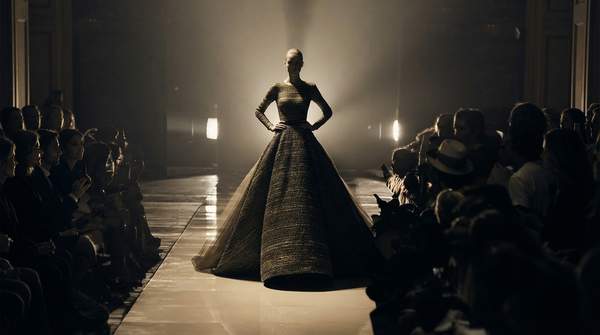
Spring 2027 is not a season of quiet clothes. Across the womenswear runways, designers moved decisively away from restraint toward personal expression, lightness and a reimagined femininity—and the garment carrying most of that energy is the skirt. Miuccia Prada and Raf Simons devoted their entire spring collection at Prada to the garment, with the famously pragmatic description of the skirt as something like a T-shirt: a universal piece capable of absorbing endless design experiments.
That combination—an expressive mood, a soft and fluid material story, and one versatile garment at the center of it—is the strategic frame for the season. For buyers and stylists planning ahead, the runway reports from Who What Wear, Harper's BAZAAR, W Magazine, The Impression and the trend service Peclers Paris converge on a coherent picture: this is the season where individuality returns, quiet luxury recedes and visible craft becomes a selling point rather than a detail.
Spring 2027: A Shift Towards Expressive Fashion
Who What Wear's runway review declared that, for spring/summer 2027, individuality returned to the fashion conversation, with designers turning up the dial on personal expression and cultivating a point of view. That editorial framing was echoed on the trade side: Svegea's outlook for garment makers noted that quiet luxury is fading while clashing prints, embellishment and visible craft are rising, led by a bright and joyful color story topped by Luminous Blue, named by the trend forecasters at WGSN and Coloro.
The backdrop, as Who What Wear's writers put it, is a world increasingly shaped by algorithms and AI. What emerged on the runways was a desire for clothes with character—chosen with a collector's instinct rather than prescribed by a single aesthetic. The hand of the artisan, the singular piece and the individual styling eye all became the season's currency.
Peclers Paris framed the same shift through its own lens. In a world of ecological, economic and geopolitical uncertainty, its spring–summer 2027 trend book positions fashion as a joyful, liberating space for self-expression, with femininity—even sensuality—at center stage and its style codes reimagined through flowing dresses, unapologetic pink, ruffles, lace, slits and plunging necklines. The distinction matters for buyers: this is not a single mandated silhouette but a mood with multiple garment translations.