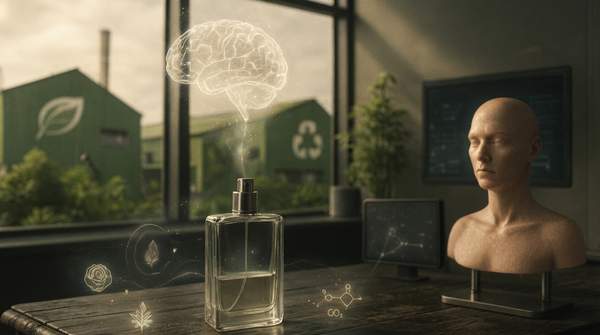
Artificial intelligence has entered the fragrance laboratory, and its role is best understood as twofold: a creative muse that suggests scent combinations a perfumer might never have tried, and an optimization engine that manages sustainability, cost, and regulatory constraints at speed. Across the development lifecycle—from ideation and ingredient sourcing to consumer preference analysis—AI now intervenes at distinct points, compressing timelines and expanding creative scope without replacing the human "nose" at the center of the craft.
The Evolving Landscape of Fragrance Creation
Traditionally, crafting a fragrance begins with the perfumer, who selects key scent elements and precise technical specifications while keeping the target consumer in mind; each candidate fragrance is then evaluated against criteria including fidelity to the designated notes, overall appeal, and character. That model is being augmented rather than overturned. Givaudan, one of the industry's major fragrance houses, describes its AI-powered tool Carto as a way to help perfumers "achieve better results than ever before," positioning digital innovation as central to its strategy of enhancing how its perfumers work and delighting customers and consumers.
The shift is also one of disclosure. Silvia Manzoni, a journalist, beauty expert, and professor at Istituto Marangoni Paris, observes that while the use of AI in fragrance design is not entirely new, brands have only recently begun to proudly disclose their processes, often capitalizing on the excitement surrounding the technology. For professionals, this means AI-assisted development is moving from a quiet back-office practice to a visible part of how luxury scents are made and marketed.
AI as a Creative Muse: Expanding Olfactory Horizons
Givaudan's Carto illustrates how AI functions as a co-creation tool. According to the company, the intuitive and interactive system "functions a bit like a game, making centuries' worth of research available in a flash." The perfumer uses a wide touchscreen to select which raw materials to mix; a special robot then produces an instant sample using real ingredients and the best possible formula, at a speed impossible with traditional methods. Givaudan frames the result as enabling perfumers to perform at the peak of their creativity, "delivering on an idea almost as soon as they dream it."
The creative expansion rests on the tool's ability to leverage advanced algorithms and vast ingredient databases—not on replacing human creativity. Manzoni makes the same point from the practitioner's side: sorting through ingredients, dosages, and combinations to create a foundation for perfumers "isn't a replacement but rather a new avenue for creative exploration." Employing AI to expedite research and analysis, as Istituto Marangoni's account puts it, allows for greater creative potential and serves as a significant catalyst for creativity, opening up new possibilities rather than invalidating the role of fragrance designers.
Neuroscience adds another dimension to the muse function. Paco Rabanne used EEG data to measure millennials' brain activity, identifying ingredient combinations for its Phantom fragrance that would evoke specific emotional responses—turning emotional prediction, not just olfactory convention, into an input for creative decisions.